A weekend in New Orleans built around the Patton Symposium at the National WWII Museum that turned into a little unexpexted time.
Trip Details
Location: New Orleans, Louisiana
Dates: March 12–17, 2026
Hotel: Higgins Hotel (Warehouse District)
Purpose: Patton Symposium, National WWII Museum
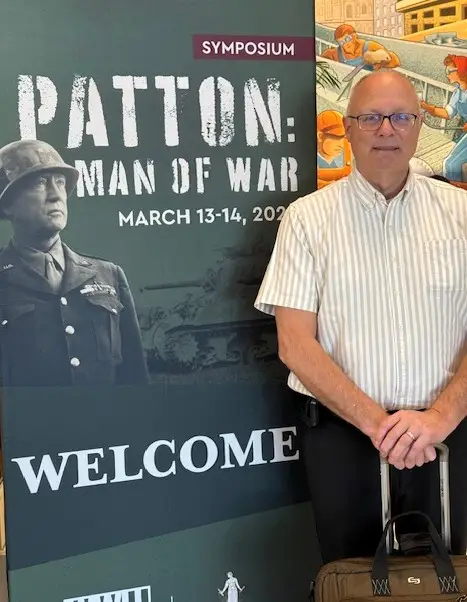
Patton: Man of War Symposium
Our March visit to New Orleans was planned as a short three-day weekend built around the Patton: Man of War Symposium at the National WWII Museum. Michael has studied Patton since he was ten years old and is now considering formal graduate work in World War II history. When the opportunity to attend the symposium appeared, he registered immediately.
What we expected to be a quick visit turned into a slightly longer stay thanks to a winter storm moving across the Midwest. (More on that later.) As it turned out, the extra unexpected time allowed us to experience New Orleans in a way a rushed weekend never could.
After checking into The Higgins Hotel and settling into our room, Michael headed across the street to complete his symposium registration.
That evening we started with a cocktail at Rosie’s on the rooftop of the hotel before walking to Pêche. Without reservations we couldn’t secure a table, but we did manage two seats at the bar. The seafood was excellent, the drinks well crafted, and the conversations with those seated nearby were lively and entertaining. Pêche is a Michelin recommended restaurant, and after our meal it was easy to understand why.
After dessert we strolled back to the Higgins, a little travel weary but excited for the days ahead.
Friday
Friday morning began with breakfast in the hotel restaurant before walking across the street to the museum. We had spent two days there in early 2025 exploring many of the exhibits, but even on this return visit we discovered new artifacts and displays.
The National WWII Museum tells the story of the American experience during the war with remarkable depth. Immersive exhibits, aircraft, vehicles, personal artifacts, and firsthand accounts bring the era vividly to life. Even for those who have visited before, the museum reveals new perspectives with each return. It is impossible to visit without the consciencous awareness of the magnitude of sacrifice for our freedoms.
By mid-afternoon we were ready for a break and stopped at Kilroy’s, the hotel bar, for drinks and a charcuterie board.
Later that afternoon Michael returned to the museum for the first symposium session. The speaker, Nathan Jones, former curator of the George Patton Museum at Fort Knox, spoke on the topic “Patton’s Shadow: The Making of a Hero in Modern Memory.” A WWII veteran and three members of General Patton’s family were also in attendance.
The Beautiful Lady in Green
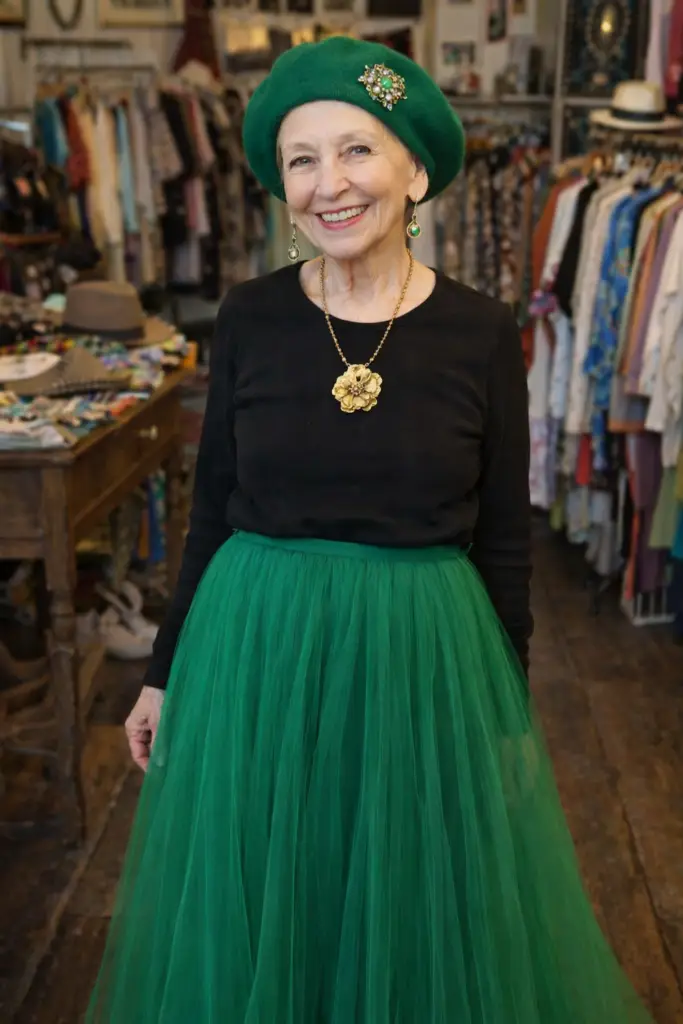
While Michael attended the session, I wandered over to Camp Street and stepped into Mad Liberation Vintage.
Inside I met a petite woman wearing a green beret pinned with a brooch and a flowing green skirt. She described herself as “seventy-five plus,” and it appeared she was quietly fighting a battle with cancer. Yet she carried herself with a striking elegance and an unmistakable joy for life. I expressed my delight in her outfit, and she smiled and replied,
“We can wear anything we want to at this age as long as it commands respect.”
Tears stung my eyes. This tiny, beautiful woman, enduring one of life’s biggest giants, was clearly living out her words.
Earlier that day I had been thinking about a pair of snakeskin shoes I noticed on a woman my own age. It caused me to ponder on what colors and styles are appropriate for women in their sixties. That brief conversation in the vintage shop tied the entire thought together and put a period on it. Eventually this became a small essay I later titled The Case for Snakeskin Shoes.
For the record, I also left the shop with the beautiful black leather jacket my new friend encouraged me to purchase.
When Michael returned to the hotel that evening, we skipped dinner and instead enjoyed champagne and beignets at Kilroy’s, a small indulgence that quickly became our evening ritual.
Saturday
Saturday morning Michael headed back to the symposium for a full day of speakers. Topics ranged from Patton’s early years prior to WWII, to military operations during the war, to reflections from those who served under him. The final session was titled “Patton in Myths, Movies, and Monuments.”
Michael’s biggest takeaway came from Roland Gaul, an expert field guide in Luxembourg and the Belgian Ardennes and 20 year volunteer for the museum. Gaul spoke about the continued admiration Europeans hold for General Patton. In Luxembourg there is still a national holiday called Liberation Day, celebrated annually to honor Patton’s role in freeing the country.
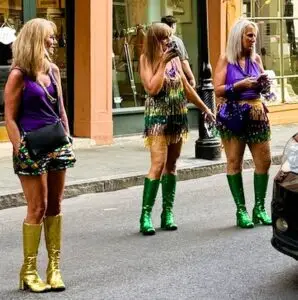
My own day began with a walk to the French Quarter to join the New Orleans Walking Food Tour. Along the way I encountered both small and large groups of people dressed in green or yellow. The green crowd wore everything from simple tee shirts to extravagant combinations of green, purple, and gold sequins. The yellow shirts featured bright bananas across the front.
Apparently, New Orleans was preparing for St. Patrick’s Day festivities, while the Savannah Bananas, an exhibition baseball team known as much for entertainment as for baseball, were also in town for two days of games.
So many people having so much fun.
Arriving at 600 Royal Street, the meeting place for the tour, our group introduced ourselves to each other, and we were off. Our guide, Jack, led us through six different stops, introducing us to a range of New Orleans classics. This included beignets, alligator sausage, shrimp po’boys, muffuletta, gumbo, and finally sugared pecans. Along the way Jack shared the stories behind each dish and tied the food to the broader cultural history of the city.
By the end of the tour I left with both a full stomach and a deeper appreciation for how closely food and history intertwine in New Orleans.
On my mile walk back to the Higgins I encountered something unexpected, a Second Line parade celebrating a newly married couple. A brass band led the procession as the bride and groom walked beneath white and black umbrellas. Family and friends waving handkerchiefs walked behind celebrating them. Only minutes earlier before ending the food tour, Jack had explained this tradition to us. Seeing one unfold in person felt like a small gift from the city.
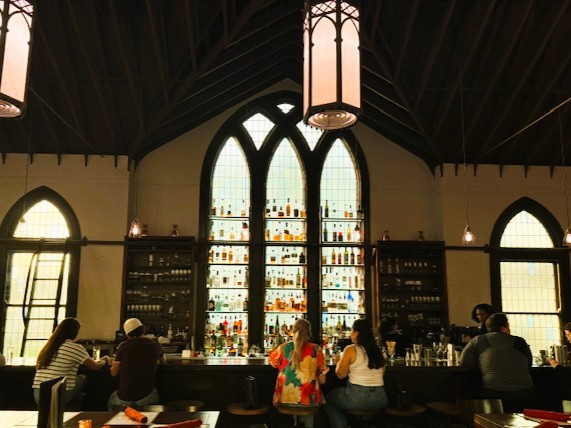
I returned to the hotel just before Michael arrived back from the museum. After a quick drink at Kilroy’s we took an Uber to Vessel for dinner.
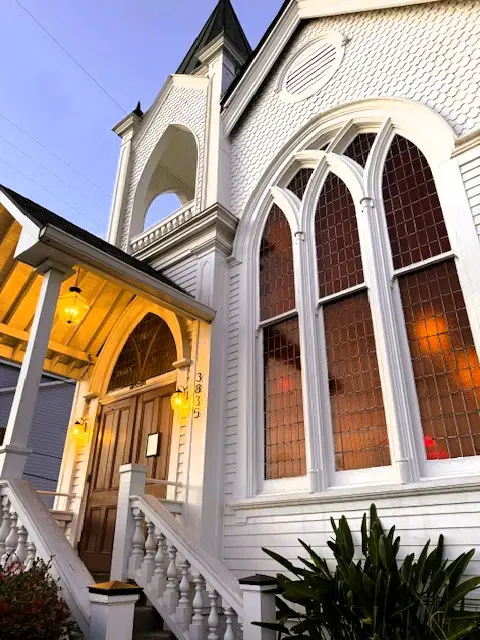
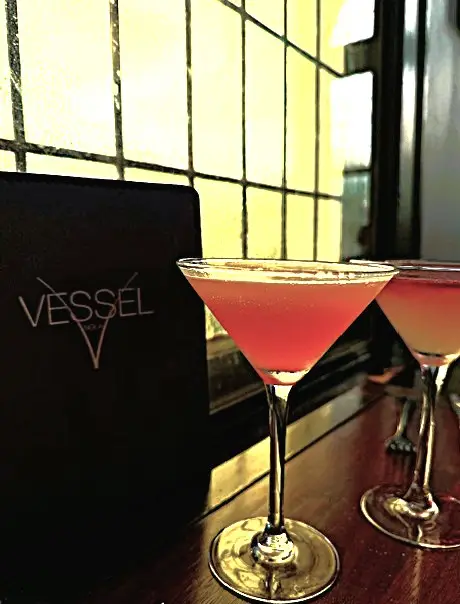
Housed inside a beautifully restored 1914 church, Vessel is as much an architectural experience as it is a restaurant. The name carries several meanings. The owner believes the finest libations should be served in the proper vessels. The shelves behind the bar are filled with distinct glassware. Second, the historic setting evokes sacred vessels used in church services. Additionally the vaulted ceiling was designed to resemble the hull of a ship.
Like many places in New Orleans, the building also comes with its own ghost story. However during our visit we encountered only excellent food, attentive service, and a remarkable setting.
Back at the Higgins we finished the evening the way we had the night before with champagne and beignets at Kilroy’s. There is something settling about creating small markers in a day during travel. This evening ritual was one of them.
Sunday
Sunday morning we set out around ten o’clock for brunch at Luke on St. Charles Avenue. I ordered oysters and a Croque Madame while Michael chose a Southern breakfast.
Afterward we wandered through the French Quarter, briefly passing through Bourbon Street before turning down quieter side streets. There we admired historic homes and the St. Louis Cathedral. Eventually we reached the Mississippi River where tugboats and barges moved steadily along the wide, muddy waterway.
From there we walked along Canal Street and stopped at the Sazerac House for a self-guided tour of the museum. We also enjoyed a Sazerac cocktail tasting in the Char Room I booked earlier in the weekend. The staff shared the story behind the famous cocktail, and its place in the city’s history.
Later that afternoon we returned to the hotel to read and write for a while.
That evening brought another walk and another restaurant. This time we dined at Meril, named after Chef Emeril Lagasse’s daughter. The lively contemporary restaurant sits in the Warehouse District a few blocks from the hotel. Our table was directly in front of the open kitchen, something we always enjoy. The kitchen staff moved with a quiet rhythm and clear coordination, each person focused on their role yet seemingly enjoying the work.
After dinner we took a longer walk through the Warehouse District before returning to the Higgins. The evening air was a warm 80 degrees with a steady breeze. Pleasant weather for two Midwesterners who knew a spring blizzard was dropping ten inches of snow back home.
At Kilroy’s we ordered a shared glass of Chartreuse and played a few rounds of Kings Corners before heading upstairs.
Monday
Monday, with no real plans, began slowly with coffee and pastries in our room. Late morning Michael returned to the museum to explore additional exhibits. He also looked further into the museum’s research center and graduate program opportunities. I joined him for lunch at Boulevard American Bistro. A game of cribbage while we ate, some quiet conversation, and then back to the museum. The cool temperatures and wind made it an appealing place to spend the afternoon.
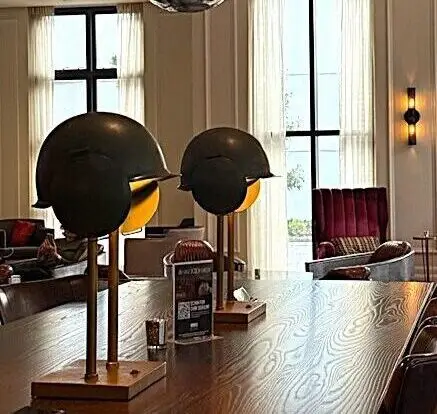
Our final evening ended as the others had begun, in Kilroy’s. This part of the hotel opens to both the lobby and the restaurant. It is beautifully appointed, reminiscent of a fine establishment from the 1940s. One of the televisions quietly plays the WWII station, often prompting conversation among the guests. Most people staying at the hotel are visiting the museum. Experiences and impressions are easily shared between strangers who quickly become temporary companions. It is a warm and welcoming place to spend an evening.
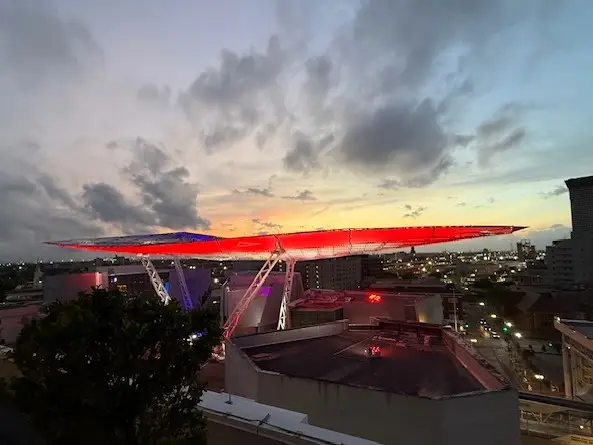
On this last night we toasted with Sazerac cocktails in honor of the city that had provided us several memorable days. Outside, the sounds of New Orleans drifted through the evening air while the lights of the Bollinger Canopy of Peace glowed across the street.
Tuesday Travel Day
Neither of us sleep well the night before we travel, and Monday night was no exception. 5:30 came around, no alarm needed, so even though it was much earlier than we needed to leave, we still left. The sunrise was a bright orange and almost neon pink, worth the early departure.
Between the government in a partial shutdown affecting TSA, and all of the airports still recovering from the massive storm, we anticipated delays. At Louis Armstrong New Orleans Airport, we walked through security as if nothing was happening. However, before landing at La Graurdia, we started getting delay notifications about our O’Hare flight. As the delays continued, the cards and cribbage board came out to pass the time. Eventually, our departure was announced, and we were homeward bound.
So how did our three-day trip turn into five days?
Overnight Friday, a winter storm began causing widespread airline cancellations across the country. Rather than risk getting stranded during our connection in Atlanta, we decided to extend our stay in New Orleans for a few additional days. Saturday morning I rebooked our flights and extended our reservation at the Higgins.
As it turned out, the decision was a good one. Our Sunday flight from New Orleans to Atlanta was cancelled, and the connecting flight to Chicago, after an eight-hour delay, was cancelled as well. One of the quiet perks of retirement we are learning is flexibility in travel.
However, the storm battering the upper Midwest and Northeast eventually swung south and slammed into New Orleans as well. Winter Storm Iona expanded to the Gulf Coast. At 2:30 Monday morning I woke to a noisy show of lightning and thunder accompanied by heavy rain and wind. The balmy 80-degree weather we had enjoyed for four days dropped suddenly to 40 degrees with sustained winds of 25 miles per hour.
A bit about The Higgins Hotel
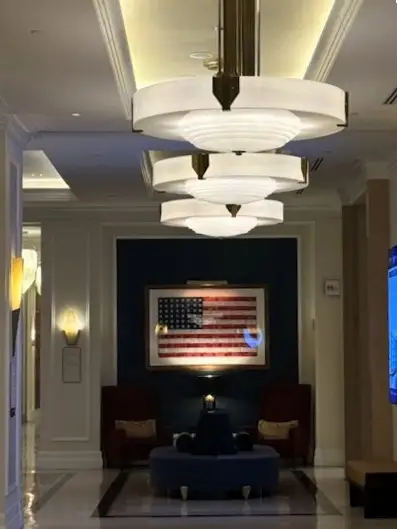
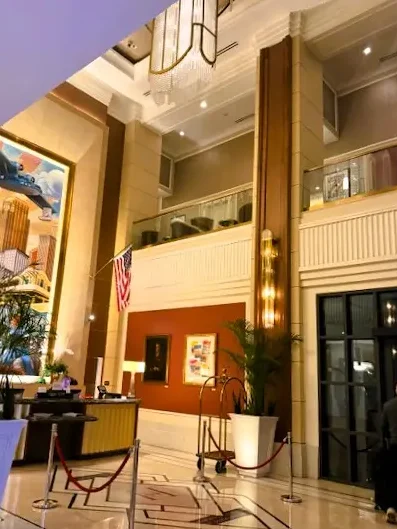
The Higgins Hotel sits directly across the street from the National WWII Museum and serves as an extension of the museum itself. The Hilton property features Art Deco interiors and subtle 1940s design elements throughout. Guests are surrounded by artifacts and historical details, including General Patton’s piano. Rosie’s, the rooftop restaurant, overlooks the Bollinger Canopy of Peace spanning the museum buildings. While we were there, the Canopy was lit in red, white, and blue against the New Orleans sunset.
The hotel is named for Andrew Higgins, the New Orleans boat builder whose landing craft helped make the Allied invasion of Europe possible. Instead of concentrating on only a few entry points, defenders had to cover more shoreline. In both the Pacific and European Theaters of World War II, Higgins Boats allowed Allied armies to move ashore.
Its location in the Warehouse District also places visitors within one of the most remarkable food neighborhoods in the country. Nearly every restaurant we visited was within a comfortable mile-long walk.
History, Food and Unexpected Time
New Orleans is a city that rarely concerns itself with subtlety. Music drifts into the streets, color appears where you least expect it, and even the architecture seems to carry its own personality. The people are quick to talk, eager to share stories about their city, and generous with recommendations for food, music, and hidden corners worth discovering.
Our trip was one we will remember, and the unexpected delay turned out to be a gift the weather decided we needed. A few extra days in New Orleans was in no way a hardship. As we travel in retirement, we are learning that the best journeys often begin when the schedule quietly falls apart.
If you’ve found yourself in a similar season, newly retired, reorienting, or simply learning to slow down, you’re welcome here.
Read what resonates. Skip what doesn’t. Stay for a moment or return later.