
April 7 – 28, 2026
Part One: Rome
The morning of our departure began with our usual coffee together, one more ordinary moment before stepping into something neither of us had ever done. Italy was ahead of us, and that had its own pull.
We left for the airport around 9:00 a.m. Traveling on a Tuesday, just after spring break had ended, felt like discovering a secret. The airport was calm, the lounge nearly empty, and everything moved with surprising ease. We looked at each other and decided then and there that retirement travel has its advantages.
After twenty years of traveling together, we approached this trip a little differently. Michael has traveled widely, but neither of us had ever been to Italy. Other than a few recently learned phrases, neither of us knew Italian. We did not fully understand the scale of Rome or whether our plans were realistic. But after twenty years together, we knew one thing with certainty: there is no one else we would rather see the world with.
Somewhere over the Atlantic, I was reminded that overnight travel changes everyone. Passengers looked rumpled and weary by morning, but so did the flight attendants. Not miserable, just tired in that practiced, professional way. It struck me that caring for a plane full of excited, anxious, restless strangers must be its own kind of endurance.
Our hotel had arranged a driver to meet us at the airport. At first, the road felt unexpectedly rural, and I wondered how far from the city we were. Then, gradually, Rome announced itself. Ancient buildings appeared as rows on the narrow cobblestone roads. Crowds were moving in every direction. The area near Vatican City was packed, even in what many would call the off season. Countless people had come before us to see these same places, and now we had joined them.
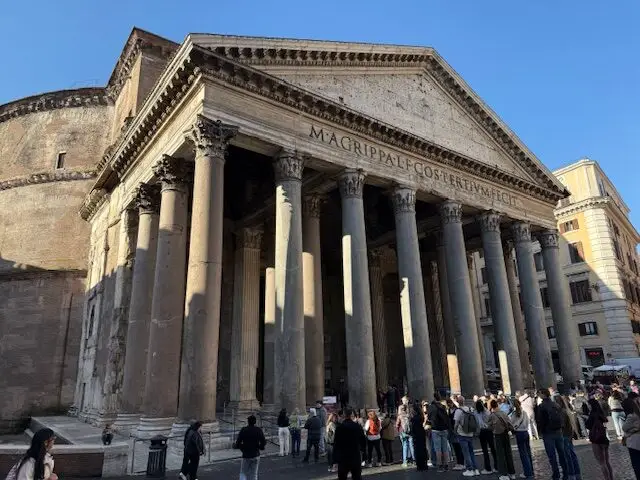
We had allowed ourselves three and a half days in the city. There is no such thing as “doing Rome” in three days, but we made a respectable first attempt. What struck me most was how many landmarks revealed themselves suddenly, almost theatrically. You turn a corner and there is the Trevi Fountain. You step out of the Metro, and the Colosseum rises across the street. Inside the Pantheon, the hush felt appropriate and deserved. Spanish Steps, no matter the hour, served as a gathering place for both residents and visitors, all talking quietly or simply sitting in the warmth of a spring evening.
For all the crowds, there was also a surprising sense of order and courtesy. People moved, adjusted, made room, and waited their turn. It was busy, but not chaotic.
We both noticed that people simply moved more slowly. We wondered whether it was the crowds or the cobblestones. One must relearn how to place each step, or risk ending up in a heap and blocking traffic. We escaped that fate, but the occasional bandaged knee on an uncovered leg suggested others had stepped and missed.
The blend of languages around us made me wonder if this was what Babel might have sounded like. Voices from all over the world layered over one another, somehow blending in harmony. One evening we stopped in Piazza di Spagna and simply listened to the melody of it all. Beautiful.
I was also fascinated by the contrast of the city itself: ancient stone and worn walls beside elegant modern clothing, beautiful shoes, polished jewelry, and effortless style. Rome does not seem interested in choosing between old and new. It keeps both.
On our last evening, we ate dinner outside at a small café just in front of our hotel. Eight o’clock feels late to Midwesterners, but there we were, settling in. Lights glowed from shop windows and restaurants. People strolled past, absorbed in their own conversations. A street seller made one final attempt at the day’s business. No one seemed rushed.
Our observation about meals in Rome, or perhaps all of Italy, was that they are not something to finish. They are a time to slow down intentionally and focus on the people at the table. The servers seemed to understand that instinctively. They appeared when needed and kept a respectful distance when they were not.
Jet lag remained my personal nemesis, and Michael was endlessly patient. At times I felt physically off-balance and mildly confused, unsure where we were headed next. At one point, intending to turn on the bathroom light, I flushed the toilet instead. We laughed hard at that.
At this stage of life, though, we have learned that when we need to stop, we stop. In doing so, we found small eateries, welcoming piazzas, very good food, good wine, and kind service. And the great thing about Rome? It is not in a hurry. It waited for us as we rested and recovered.
More time would have been welcome, and I suspect we will return. Three and a half days was a good beginning. Rome did what great cities do. It left us grateful, a little overwhelmed, and wanting more. We left to continue north with a different sense of time and place. It was a fine beginning to the journey.
Part Two: Cortona
On Saturday morning, we left for Cortona from the vast and bustling Roma Termini Railway Station. Although we arrived with time to spare, we somehow managed to be standing on the wrong platform when boarding began. So before our journey north officially started, it began with the two of us running across the station, probably ten miles, or perhaps half a mile, depending on how dramatic one chooses to be. The train was delayed, which proved fortunate for the Benners, who boarded breathless but successful.
Train travel in Italy can be unpredictable. That Saturday there was a transportation strike, something not uncommon in Italy and usually limited in timing. It slowed the system considerably. Our trip was otherwise uneventful, though we arrived nearly two and a half hours later than planned. Thankfully, our driver was also collecting another group of four travelers who had arrived on time. We would cross paths with this cheerful group from Montana several more times during our stay.
Cortona sits high on a hillside overlooking the Val di Chiana. Enclosed by ancient Etruscan walls and shaped by centuries of Roman, medieval, and Tuscan influence, it is one of those places that seems to rise naturally from the landscape. Olive groves, vineyards, stone buildings, and sweeping views surround it. The town feels both elevated and deeply rooted, as if it has been quietly watching the centuries pass.
We did not exactly find Cortona. Rather, it found us through a package we purchased at auction during an event at Hidden Creek Estates. ***More on that later.
The steep streets inside the city walls can be challenging. Some require climbing steps, and plenty of them. Others are so sharply angled you find yourself leaning forward just to continue. Nearly all are cobblestone, so while climbing hills, you must also pay close attention to where you place your feet.
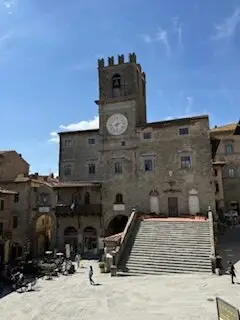
The two main gathering places, Piazza della Repubblica and Piazza Signorelli, serve as the social heart of the town. Throughout the day, visitors, schoolchildren, locals, and tour groups cross through the squares in a steady rhythm. Cafés and bars line the piazzas, busy from morning espresso through evening aperitivo.
In Italy, a bar is not simply a place for cocktails. It is also where you stop for coffee, sparkling water, a pastry, or conversation. Families gather there. So do older men who look as though they have been meeting at the same table for fifty years. Babies in strollers roll by while neighbors greet one another. Life unfolds publicly and naturally.
While the bars provided lively entertainment, they also provided lively sound, often until three in the morning. Unfortunately, our first apartment sat directly above two of the busiest establishments in town. As if that were not enough, we also had residents above us in the form of pigeons.
A flock of pigeons had taken up residence in the attic space above our bedroom, accounting for the dust, the smell, and the suspicious noises overhead. Around 6:30 each morning, just as the street below had finally quieted, the pigeons would begin their own day. Scratching, flapping, clawing, cooing, and what sounded like aggressive furniture rearranging would continue for the next forty-five minutes.
Because of the noise, a cleanliness concern, and the fact that the bedroom required climbing thirty interior steps, we were graciously moved to a quieter, newer, and far more comfortable apartment a few blocks away. It was close enough to the center for convenience and far enough away for sleep, a beautiful compromise.
Now, back to the restaurants.
There are so many eateries in Cortona that it would take quite some time to experience them all. Nearly every one offered excellent wines from Tuscany, Umbria, and the Chiana Valley, along with beautifully prepared pastas, seafood, veal, and regional specialties. But the charm was not only on the plate. Each interior had its own character. Brightly glazed ceramics. Etched glassware. Stone walls that have stood for centuries. Family photographs. Local artwork. Dining there satisfied the eye as much as the appetite.
Tables spilled into the streets from cafés and ristoranti. Indoor seating existed, but most people preferred to eat outside. Many afternoons we did the same, sometimes talking, sometimes saying nothing at all as we watched people pass by.
The shops were equally inviting. Leather goods, clothing, shoes that nearly demanded to be purchased, jewelry, and art galleries tucked into old stone buildings. For me, the art shops were pure refreshment.
At Il Pozzo Galleria d’Arte, we spent several hours with the owner, listening to stories of restoring the building that now houses works from various artists. We shared prosecco, because in that setting, one simply does, and while Michael and Ivan discussed the engineering of ancient buildings, I wandered among paintings, papyrus works, leather journals, handbags, and handcrafted jewelry. I was especially drawn to a silver and gold piece, and my generous husband kindly agreed that it should come home with us. The building also contains an old cistern, now home to koi. Softly lit and beautifully restored, it was remarkably calming to sit beside and watch.
I could not tell you how many churches and chapels are tucked into this hill town, only that they are plentiful. Each seemed lovingly maintained. Frescoes, painted ceilings, carved wood, marble altars, brass details, and centuries of devotion remain visible in every one. The highest and most prominent is Basilica of Saint Margaret of Cortona, perched above the town. We climbed there on foot, requiring several rest stops along the way, but it was worth every step. Inside, the stillness and reverence of the space offered deep rest.
As we descended back toward the city center, church bells from across the town began ringing together. Even now, remembering the view, the sound, and the grace of that moment brings tears to my eyes.
Two of our days were rainy, but Cortona had plenty to offer indoors. We visited the MAEC Museum, which was hosting a World War I exhibit alongside several floors of Etruscan history. The displays were fascinating and beautifully preserved. We also visited Circle of Life Art Gallery, founded by sculptor Andrea Roggi. His contemporary bronze castings centered on the connection between earth, humanity, and life, were remarkable.
And when the rain lingered, there were always wine shops offering tastings led by knowledgeable and entertaining sommeliers. We brought a deck of cards with us, so on afternoons too cold, wet, or windy for wandering, we played Kings in the Corner over another glass of exceptional wine.
Our time came to a close on Saturday, April 18, and we left with hearts of gratitude for this stay in the City on the Hill. We headed north from there, again via train, albeit a much calmer exit then our entrance to Cortona.
How Cortona Found Us
Our seven days in Cortona came through a package we purchased at auction during the Joey Fecci Foundation 2025 Food & Wine Festival, hosted by Hidden Creek Estates. Joey was a young aspiring chef in Nashville who tragically passed away on April 27, 2024, at the age of 26. He was a dear friend of the Frank family, owners of Hidden Creek Estates.
The festival was created to honor Joey’s memory and his love for the culinary arts. It is a day filled with exceptional food, wine, music, and live entertainment. Celebrity chefs generously donate their time and talent, each hosting their own tasting station for guests to enjoy. Proceeds from the event are given in Joey’s honor to support the next generation of chefs.
Part of Part Two: Siena and Florence April 2026
Michael wanted to see the Piazza del Campo in Siena, where the famous horse races are held twice each year. I wanted to stop in Florence to see David. So we compromised, and we did both. A day trip to Siena, followed by an overnight stop in Florence on our way from Cortona to Monforte d’Alba. That is how marriage works when you make it.
Siena
We arranged for a private driver from Cortona and arrived in Siena for breakfast, ready to explore. We wandered the winding streets until we found our way to Piazza del Campo, where we met our walking tour guide, Anna. She was wonderful, a petite, middle-aged woman, with long dark curly hair, olive skin, and the kind of warmth and confidence that made history come alive.
Anna first showed us two newly opened bars, one of them located inside the historic Accademia Musicale Chigiana, a renowned music institute founded in 1932 by Count Guido Chigi-Saracini as an international center for advanced musical study. Through her connections, she was able to take us beyond the restaurant space and into the preserved private rooms of the Count’s residence, which is not generally open as a museum. It was extraordinary.
From there we continued to the magnificent Siena Cathedral, dedicated to the Assumption of Saint Mary. Anna explained the layers of architectural history, the sculptures, the intricate marble floor inlays, and the significance of Siena’s twelve contrade, or districts, each represented by its own flag.
We passed the great medieval hospital, Santa Maria della Scala, where Saint Catherine of Siena once cared for the sick before her death at only thirty-three years old. As we continued through the streets, Anna pointed out cafés and hidden corners before bringing us to Basilica of San Domenico, where the stained glass was breathtaking.
It was a day rich in art, faith, and history.
Florence
Saturday morning found us boarding another train, this time to Florence. It was a far calmer departure than our earlier station sprint in Rome. No confusion, no strikes, no drama. Just a smooth ride north.
We arrived at the station with no transportation plan in place. The app would not work. Texting failed. Then, as if on cue, a taxi appeared out of nowhere. Off we went.
We checked into The Social Hub Florence Lavagnini. Very modern, very youthful, very hipster, and we were a little outside the target demographic. Still, it was a fun and interesting stay.
We headed to the rooftop for a quick refreshment. There, stretched across the skyline, stood the glorious Florence Cathedral. While we admired the view, the Italian Air Force flew overhead in formation, trailing the green, white, and red of the Italian flag across the sky. Another breathtaking moment.
Next we walked to the Leonardo da Vinci Interactive Museum, which features more than fifty full-scale models of Leonardo’s inventions along with reproductions of his paintings. For anyone visiting Florence, I would call it well worth the stop.
Lunch followed, where we enjoyed what may have been the best lasagna and Chianti of the trip, or perhaps I was simply starving.
Then came the Galleria dell’Accademia. We waited only about thirty minutes, very manageable on a pleasant spring afternoon. In the height of summer, I would absolutely recommend advance tickets.
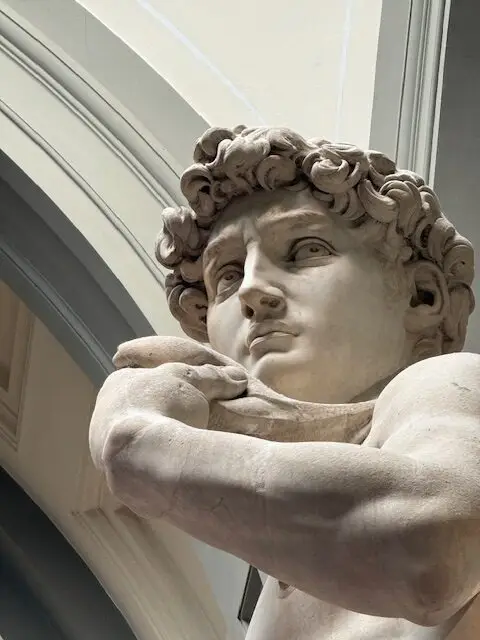
Walking into the great hall where David stands was unforgettable. Lit from above beneath the dome, he seemed almost to glow. I had not expected the many additional Renaissance works housed there, which made the visit even richer.
Afterward we walked around the exterior of the Duomo and Baptistery. By then, after a long day, it was enough simply to admire them from outside.
That evening, Tim had recommended Locale Firenze for dinner. He was right. The décor, food, and service were all exceptional.
Sunday morning, we rented a car and headed north and west toward the Piedmont region, ready for the next chapter of the trip.
Part Three: Monforte d’Alba: Castles, Vineyards, and Wineries
Leaving Florence, we took a taxi to the airport car rental office, picked up a Peugeot 2008, and set out for Piedmont. Michael drove carefully while learning the rhythms of Italian roads. He had studied the signs the night before, but we quickly discovered that highways and side roads are not always as straightforward as back home. At times, we wondered if getting lost was part of the national character. Still, we made it out of the city, onto the A1 north toward Milan, and eventually turned west.
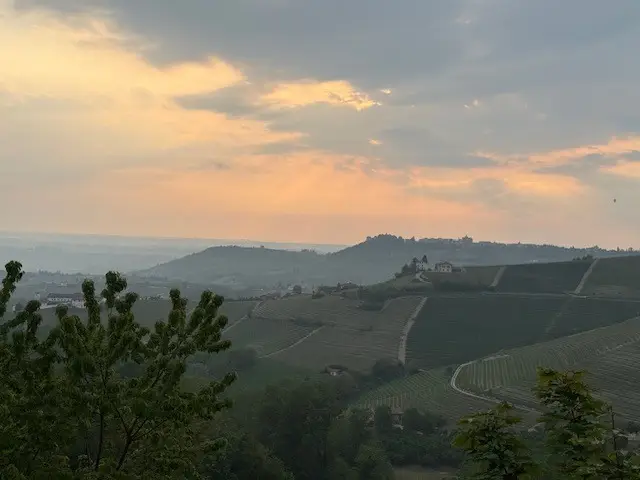
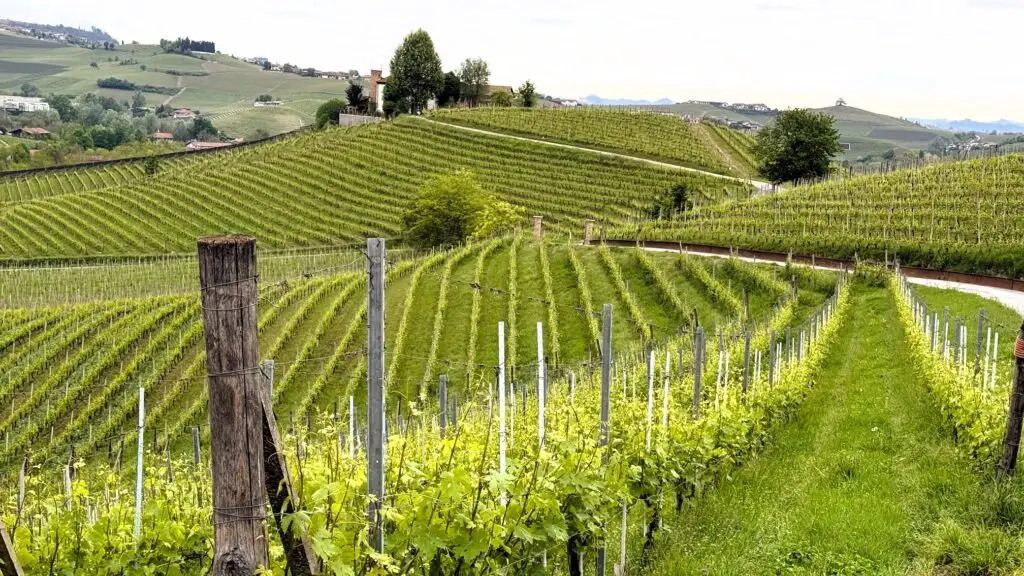
A few hours later, heading south again, wine country appeared in full glory. Rows of vines covered the rolling hills like a giant green patchwork quilt. We fumbled with directions more than once, but eventually found our way to Franco Conterno Agriturismo Cascina Sciulun.
I had booked this stay, along with our next one in Sestri Levante, during some very early morning hours only a few weeks before the trip. Booking accommodations at dawn may not be best practice, but in this case it worked. We were delighted to discover we would spend four days on a working winery, surrounded by acres of vineyards.
Our hosts, busy with the starting season, always had a kind greeting, time to make a European continental breakfast each morning that started our days feeling cared about, and making sure our room was always in pristine order. Their hospitality will long be remembered.
Our room had a large veranda overlooking the family’s vines, with views stretching to Barolo and La Morra on the western hills. Everywhere we looked were vineyards, wineries, and hill towns that once held castles or fortified walls. Our hosts also had an east-facing patio with comfortable chairs and warm blankets. Each morning we sat there with coffee, Americanos for me, cappuccinos for Michael, until the day slowly introduced itself.
By then, the sightseeing portion of our trip had softened into something better. We no longer felt the need to chase landmarks. Our days became drives through vineyard roads, wandering castle towns, stopping for lunch, coffee, or a glass of wine whenever it seemed right. No one appeared to be in a hurry.
Except the vineyard owners.
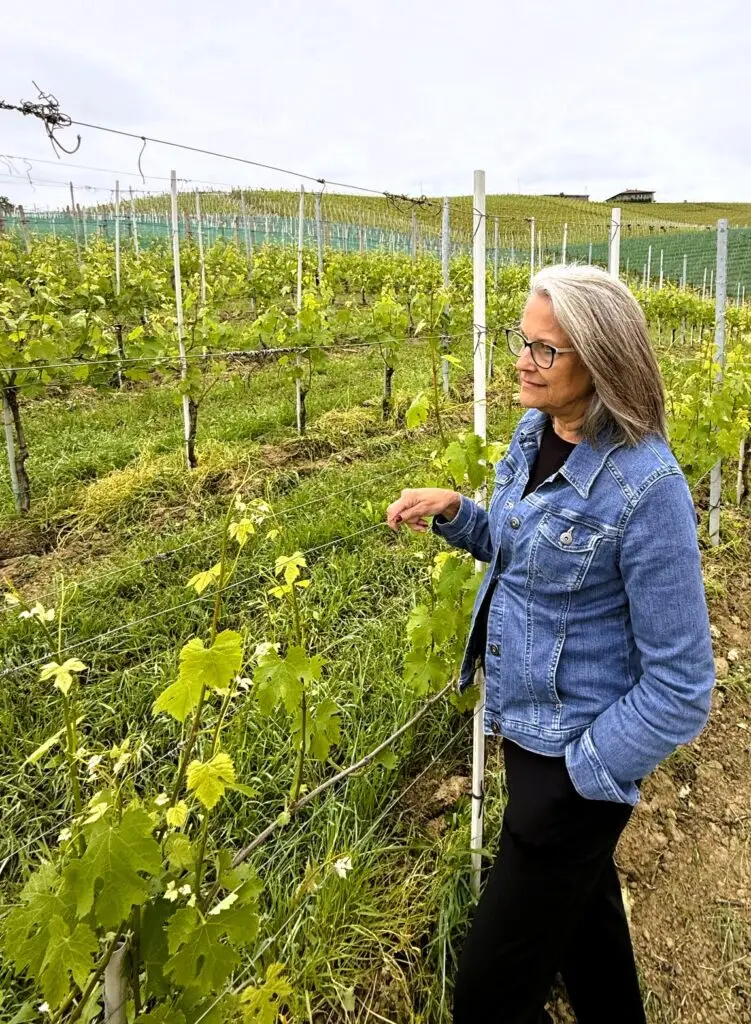
This time of year, the grapes were just beginning to form. We could almost see the vines changing each day. Crews were pruning and tying by hand, and by eight each morning the small tractors were already moving down the rows, carefully cultivating the soil. A vineyard is a living thing. It demands attention in every season, because no part of its life can be neglected without consequence later. What appears effortless at harvest is built through months of pruning, watching, repairing, and patient daily care long before the fruit is ever seen.
I said I could smell the earth as it was being worked. Michael said the tractors on metal tracks sounded like distant WWII tanks rolling across a ridge. Naturally, we were both right.
One evening, we met a former colleague of Michael’s from his years at Honeywell for dinner in Monforte d’Alba. They had not seen each other in eleven years, since their days working from the company office in Switzerland. Over sunset, a wonderful meal, and two bottles of local wine, they talked about old coworkers, world travel, and retirement. Two men who had spent decades moving at full speed, now learning a different pace. When dinner ended, a hard rainstorm met us outside and gave Michael another lesson in Italian driving. We found ourselves on dark roads, unfamiliar signs, steep hills, and one accidental detour into the wrong valley before GPS rescued us.
We celebrated our twentieth wedding anniversary while staying at Cascina Sciulun. It was a cold, misty morning after the storm, but the weather could not touch the gratitude of the day. We found each other in the middle of life, and somehow twenty years arrived faster than either of us expected.
After breakfast and our usual slow coffee, we drove to Serralunga d’Alba for lunch at Osteria Tre Case, a modern restaurant that still gracefully showed its ancient bones. The meal was one of the best of the trip. Beautifully set tables, warm hospitality, and food worthy of an anniversary toast. It was the perfect place to reflect on all we had shared.
Our next stop was Ettore Germano Winery. We had met Sergio Germano at a wine dinner back home in March and were invited to visit if we found ourselves nearby. That afternoon the family and crew were busy capping bottles of their 2022 Alta Langa Brut, one of our favorites, preparing it for shipment in the months ahead.
We were fortunate to visit on a rare and busy production day, just as the bottles of Brut were being disgorged. The temporary caps were removed, the sediment expelled, and the wine prepared for its final closure with the traditional mushroom cork and wire cage. Watching that last stage of the process was a special glimpse into the craftsmanship behind a bottle that usually reaches the table with all the work hidden from view.
For Michael, with his manufacturing background, and for me, having worked in agricultural finance, it was fascinating to witness the production side of the business. After watching the bottling line, Paola guided us through the winery, explaining their vineyards, winemaking, and family history. She also introduced us to five wines we had never tasted before. Their tasting room was extraordinary with an expansive view of their generational land and vines.
It was one of those experiences travel occasionally gives you: unplanned, personal, and impossible to recreate.
We ended the day with dinner at a lovely country restaurant, then returned to the Cascina to pack for the final leg of our trip. Our bags were readied once again, but we left with more than what we had brought. We carried the quiet beauty of those hills, the kindness of the people, and memories that would stay with us long after we had gone.
Part Four: Sestri Levante on the Ligurian Sea
We ended our stay at the Cascina with breakfast and warm goodbyes, then drove north and west to Genoa Airport to return our rental car. It should have been a simple drop-off, but between unfamiliar traffic patterns and road signs seemingly designed for hummingbirds, it took some effort. Once sorted, our driver, Umberto, met us, and soon we were traveling east along the coast beside the brilliant blue waters of the Ligurian Sea. The moment I saw it, my spirits lifted.
Sestri Levante, our final stop, is perfectly placed between Rapallo, Portofino, the Cinque Terre, and within reach of Pisa. During one of my late-night booking sessions, I found what was described as “a seaside apartment with great views.” Experience has taught me that such wording can sometimes mean one tiny glimpse of water if you lean out a window at the proper angle.
This time, it meant exactly what it promised. It was perfectly named Sogno sul mare meaning “Dream on the Sea”.
The owner, Stefano, met us outside and led us upstairs to the second floor (third, by our counting). The moment we walked in, I wanted to book it again for some future date we had not yet planned. There were sweeping views of the sea from two sides, a wraparound balcony, and the kind of comfort that instantly tells you to exhale.
Stefano shared that we would be his final guests, as he had sold the property. Short-term rental regulations had made profits harder to sustain, and with retirement approaching, selling made sense. He was a gracious host throughout our stay, checking in on us, offering dining suggestions, and even inviting us to remain a few extra days at no charge. We could not accept, but we appreciated the kindness.
Sestri Levante is known as the “City of Two Seas,” built around a rocky peninsula called Isola Peninsula that reaches into the water. On one side lies the smaller, sheltered Bay of Silence. On the other is the broader Bay of Fables, where we stayed.
The dark, rocky beaches were filled each day with families, couples, and sun-seekers stretched across towels and smooth stones. Even in the cooler temperatures, some determined souls were swimming.
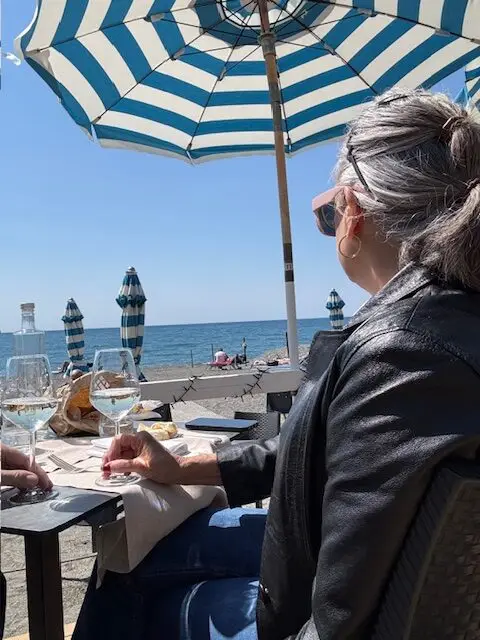
Small cafés lined the beach and the wide Promenade along the Bay of Fables. Our days followed a rhythm of coffee and breakfast on our balcony, lunches by the water, coffee and a sweet in the afternoon, an occasional aperitif, and morning and evening walks among the other strollers making their slow circuits along the sea.
Away from the waterfront, we spent time in the Old Town, which deserves to be wandered rather than visited. Pastry shops, cafés selling slices of pizza, gelato counters, and a shop making fresh pasta daily seemed to appear on every street. There were leather goods, artisan jewelry, and clothing elegant enough to suggest it had just arrived from Milan. Between the aromas, the shop windows, and the people watching, we took the long way every time.
We noticed that the people of Sestri Levante were likely residents or Italians traveling to the sea. Not much English was spoken in the crowds. Stefano told us that most tourists want to stay in Portofino with a faster pace. More appears to happen there than in Sestri Levante. Those who travel to or stay in this city are looking for quiet and anonmity. We were good with that.
During our final four days, we spent a lot of our time on our balcony, soaking in the sun, listening to the waves, and resisting any urge to do more than necessary. The nights were cool, but we left the windows open so the sound of the sea could follow us into sleep.
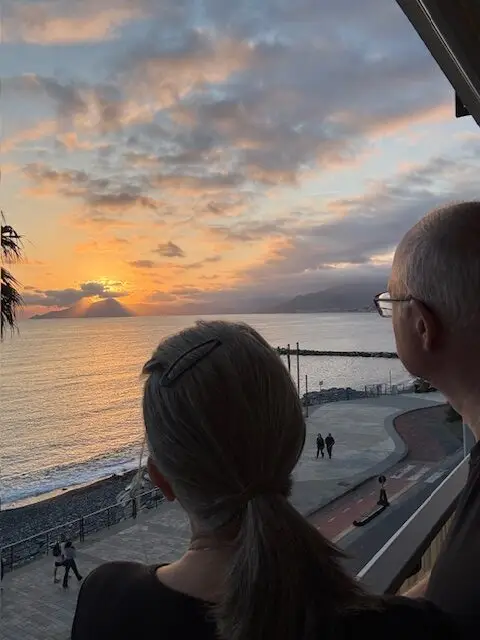
The sunsets were breathtaking. We never missed one, staying outside until the sun disappeared behind the mountains across the bay. We talked about what we were grateful for during the trip. The list was long. That in itself is a blessing.
Part Five: Home
This morning we returned to Rome by train, and tomorrow we fly home. When this journey began, I expected we would return with much to discuss and perhaps a few profound conclusions neatly tied together. The truth is less dramatic and more useful.
Planned or not, each day unfolds on its own terms. Sometimes it goes as expected, but you might miss a turn, get lost, and find something you would never have discovered otherwise.
Being away from home for so long placed us both on unfamiliar footing. I do not only mean cobblestones, though they certainly played their part. There were times I found the moving from place to place a little unsettling. Michael, in his own way, missed the daily structure he had begun building at home.
Packing, unpacking, and packing again should have become easier with practice. It did not. We have concluded that learning not to overpack must happen before any future expedition. This may be the clearest wisdom Italy gave us.
We also learned that kindness matters most when tiredness arrives. Jet lag can make one of us unreasonable. Missed turns can add unexpected hills, extra blocks, and more stairs than anyone ordered. In those moments, grace is more valuable than efficiency.
During our travels, we also found ourselves keeping a running list of movies made in or about Italy. With our slower pace in Sestri Lavente, we rented two and watched them late in the evening after dark. The first was Under the Tuscan Sun, set in Cortona. It was fun to recognize the piazzas, overlooks, and even our first apartment building in scenes we had just walked past ourselves. The second was Roman Holiday, with Audrey Hepburn and Gregory Peck. Many of its scenes were places we had already visited in Rome.
I mention that not because watching movies is some grand travel achievement, but because travel enlarges your world. Returning to those places through film gave us another way to understand them, and perhaps to understand a little more about the lives lived there.
But those are small lessons inside a larger one.
The most interesting lesson was we realized that we no longer vacation. Vacations once belonged to working life. Our vacations consisted of carefully rationed days approved by someone else, to be used wisely because they were limited and slow to return. What we do now is travel. Our trips are shaped by the boundaries we choose, like finances, family calendars, grandchildren’s birthdays, and common sense. Within those boundaries, time feels different. We are no longer racing a clock or mourning the final days before returning to obligation. We can enjoy where we are, move when it is time, rest when it is needed, and let the experience unfold.
Three weeks in Italy have given us memories that will remain and reasons to return. But for now, there is also a good life waiting for us at home.
Planes, Trains & Automobiles by Michael
Catherine begins Part 5 by mentioning our train ride back to Rome. That reminded me of the movie title Planes, Trains and Automobiles.
During this trip, we used plenty of all three. We flew on four aircraft: an Airbus A330 twice, a Boeing 737, and finally an Embraer 175. We took four trains: a local passenger train from Rome to Cortona, an intercity train to Florence, another from Sestri Levante back to Rome, and finally the Leonardo Express to Leonardo da Vinci International Fiumicino Airport.
Italy’s rail network is excellent, with an impressive number of tunnels cut through mountains, and service that makes long distance travel practical and comfortable.
Automobiles included a bus ride to O’Hare International Airport, another at the Rome airport to and from a hotel. We rode in a BMW van transfer from the Rome airport into the city, three van trips while staying in Cortona, four taxi rides in Florence, and a Peugeot 2008 Hybrid rental car. It was a sporty little SUV that handled the mountain roads like a rally car.
And in between all of that, we walked.
The range of transportation on this trip was very different from life in the United States, where we usually just get in the car and drive to wherever we are going. After this experience, I could get used to taking the train much more often.