July 21 – August 1, 2026
The Royal Scotsman. A Trip of a Lifetime Part One
The Royal Scotsman, a three day luxury train journey we had looked forward to for a long while, was the reason our twelve day trip to Scotland took shape in the first place. The trip centered on whisky, on the distilleries that make it, and on how closely that history is woven into Scotland’s own. Our route ran from Edinburgh up to Inverness, back down along the North Sea coast, and finally home again to Waverley station where it had all begun.
Our Trip on the Royal Scotsman Begins
The Balmoral itself set the tone before we ever reached the train. Walking in felt like stepping back into an earlier era, the same feeling we would find waiting for us on the Royal Scotsman later that day. The concierge and bellmen wore kilts in a specific tartan. They matched the Belmond staff for warmth and attentiveness. While we waited for lunch and departure, Belmond had set out postcards and stamps for anyone who wanted to use them. This small touch mattered more than it might have another time. Most of us had either just come from somewhere or were headed somewhere else entirely once this trip ended.
Ali, our host for the coming three days, made a point of getting to know each guest individually. I mentioned to him that we had not brought any tartan for the formal dinner, since neither of us has Scottish ancestry. He waved off the concern, then went further than he needed to. He looked up and found a tartan pattern for the state of Illinois and another commemorating America’s two hundred fiftieth anniversary. Neither was necessary. Both told me something about the kind of attention we could expect for the rest of the trip.
Belmond invited us down to Prince’s Restaurant for a quick lunch. I had a Caesar salad crisp enough to taste like it had been picked that morning. Michael’s beet salad looked almost too well built to eat. Our waiter, noticing the Belmond tags, lit up over our trip ahead and spent a moment telling us what to look forward to. We finished lunch and gathered with the rest of our group, thirty four guests in total, before making our way to the train.
Greetings and Introductions
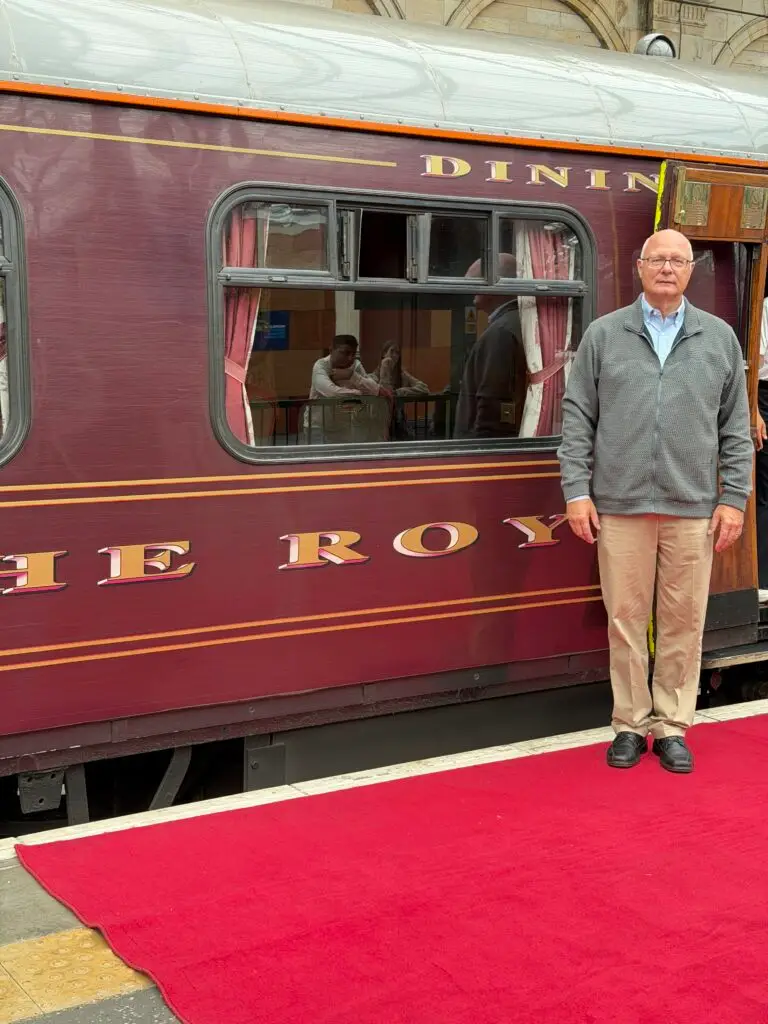
A single piper in full Highland dress met us on the platform, though the sound filling the terminal made it seem like three or four were playing at once. Michael had dreamt of this trip for years, and we held hands and just listened. The piper played on as he led our group in a procession across the red carpet toward the boarding area. The staff greeted us by name again as we stepped aboard.
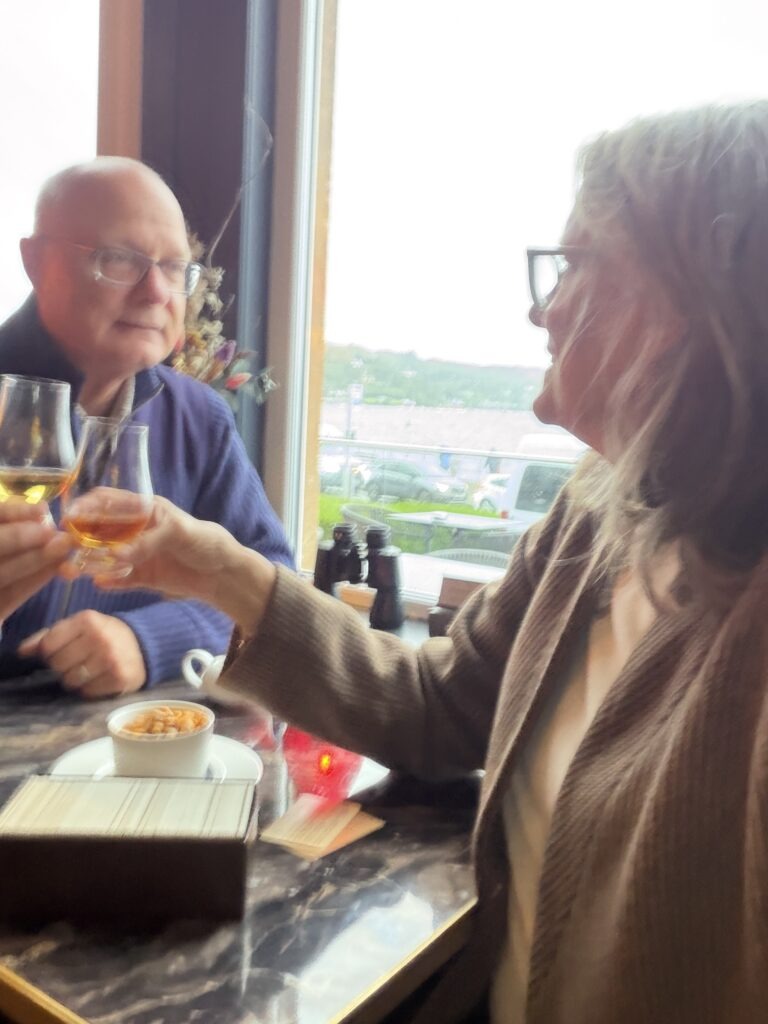
The staff gathered us in the observation car for a toast welcoming everyone aboard and looking ahead to three days of kinship. Ali, our host, taught us to say Slàinte Mhath properly, the traditional Scottish toast to good health. Half the car spent the next minute practicing the pronunciation and laughing at ourselves.
Stepping into Historic Train Travel
Walking through the cars for the first time, everything struck me as beautiful in a way that felt lived in rather than staged. The chairs and couches, even the pillows, with attendants quietly tidying behind us as we passed, were part of a beautiful picture. Each dining car had its own look, one done in red, the other in a soft green, both set with the Royal Scotsman’s own signature china pattern and crystal against polished wood paneling. Windows ran the length of the corridor connecting each car, so even walking from one end of the train to the other, you never quite lost the passing landscape. Those corridors were narrow enough to be genuinely tricky. I collected a bruise or two on my shoulders before I learned how to move through them properly.
Our cabin was a twin, one of three room sizes offered on board, with two twin beds, a small desk and stool, a side table, a narrow closet, and a bathroom with a shower tucked into a surprisingly small footprint. Everything about it was comfortable and well appointed, though getting ready for the day or evening meant a bit of a dance, working around each other in a space that rewarded patience more than speed.
The People Who Made the Trip
Part of what made the trip so alive was the mix of people on board. Couples and travelers had come from Thailand, Singapore, Taiwan, Austria, Germany, Belgium, France, and across the United States, and that range gave the whole journey an intrigue it would not have had otherwise.
A couple from Nashville gave us several of the best conversations of the trip, ranging across travel, whisky, family, and even a book I had illustrated for a friend. We exchanged contact information there too.
Two sisters from Taiwan, both in their fifties, were on a long awaited trip together, and their joy was contagious. They approached every excursion and every host with the same open enthusiasm, and it was hard not to smile watching them.
The newlyweds from Thailand could have won a prize for best looking couple on board. They kept mostly to themselves, but what we did see of them was quiet, kind, and clearly happy.
The Chicago couple lived only sixty miles from us, a detail that made our path crossing feel a little more like fate than coincidence. We never quite landed in a real conversation while on board, but we found one during the departure process, trading notes on our careers and how much we’d both enjoyed the trip. I gave them my card before we parted, with an invitation to get together for dinner sometime.
The Journey Begins
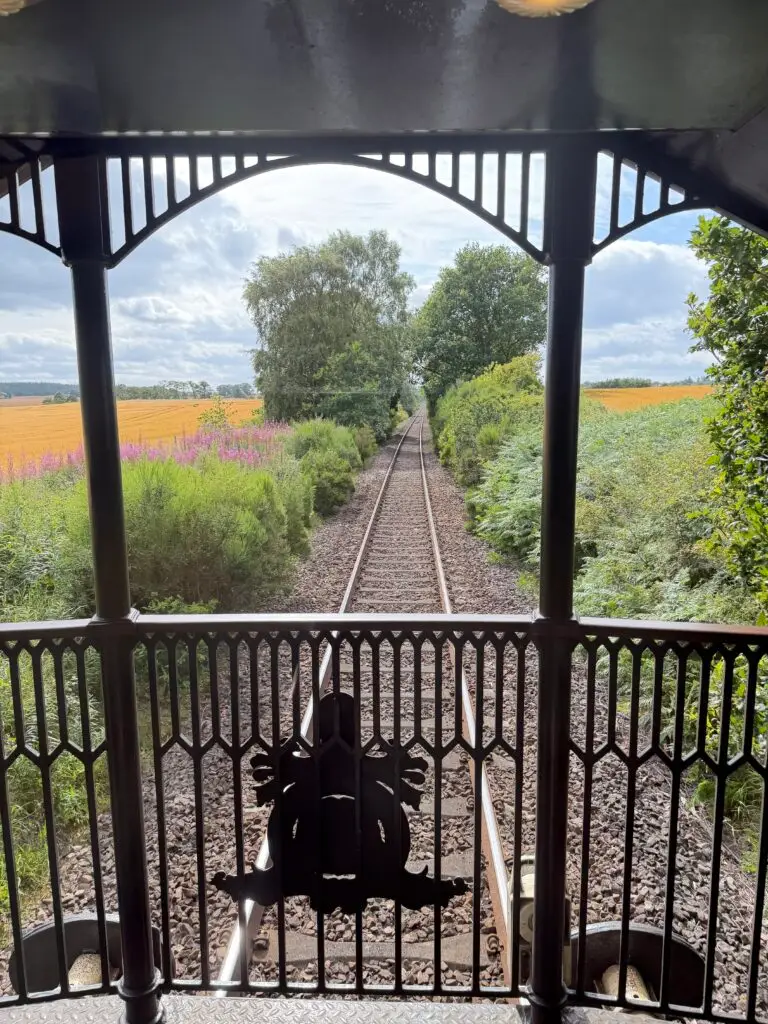
The train left Edinburgh and traveled north through the Scottish countryside. During the remainder of the afternoon, Michael spent time visiting with other train enthusiasts, standing out on the observation deck at the rear of the train and learning more about the operations from the conductor and other members of the team.
I treated myself to a facial in one of the rooms in the spa car. It was a totally relaxing experience, provided both by the esthetician and the very slight rocking of the railcar.
Michael did not expect to find this on the trip. Most of our fellow travelers came for the excursion itself or as seasoned train travelers, but few carried his depth of interest in the history behind it all. Meeting Alistair, a railfan and model railroader celebrating his fiftieth birthday with his wife, gave Michael someone who spoke his language from the first conversation.
Phil, another gentleman Michael visited with, turned out to be a railfan and model railroader too, and a devoted student of World War II history on top of it. Michael still appreciates the hours he spent with both men. I found my own company in their wives, Theresa and Tina. Both women had a quick, lively humor that had me laughing within minutes of meeting them.
Drams of Whiskey and Plates of Food
We both participated in the first of several whisky tasting and history lessons in the late afternoon. The Scottish past is interwoven with struggles and triumphs, all of which make it as rich as the whisky.
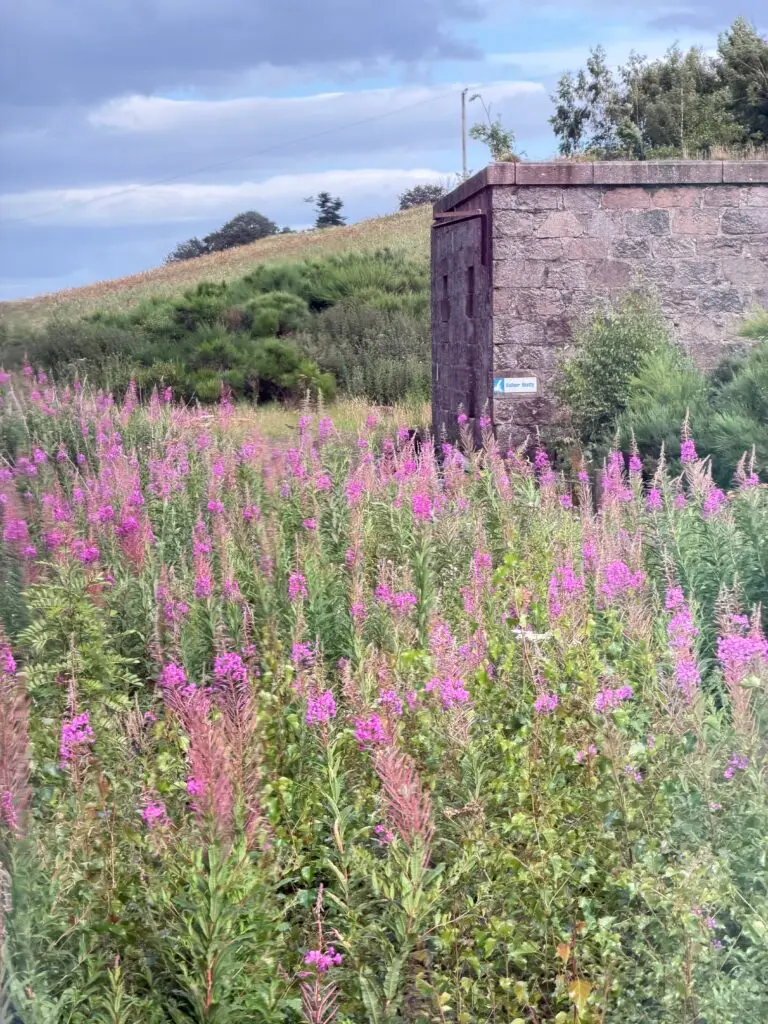
Dinner was a semi formal event, the dining cars beautifully appointed, and the meal, prepared by a professional chefing staff, served by the incredible staff. Music by fiddlers followed, with more opportunities to try whisky options from throughout the country. The evening came to a close, and we retired to our cabin and settled in for the night. The train was stationary, having parked in Boat of Garten for the night, so we slept restfully in the quiet countryside.
Friday Comes to a Close
We both participated in the first of several whisky tasting and history lessons in the late afternoon. The Scottish past is interwoven with struggles and triumphs, all of which make it as rich as the whisky.
Dinner was a semi formal event, the dining cars beautifully appointed, and the meal, prepared by a professional chefing staff, served by the incredible staff. Music by fiddlers followed, with more opportunities to try whisky options from throughout the country. The evening came to a close, and we retired to our cabin and settled in for the night. The train was stationary, having parked in Boat of Garten for the night, so we slept restfully in the quiet countryside.
Saturday Begins a Busy Day
The next morning we were offered several breakfast options, including a power shot of beet and apple juice, before boarding a coach that was part of the Belmond fleet, just as luxurious as the train with tables and seats facing each other for easy conversation. Wildfires were burning across parts of the Highlands that week, so instead of riding the coach the whole way to the Rothiemurchus Estate, we switched partway to Range Rovers for the second half of the drive.
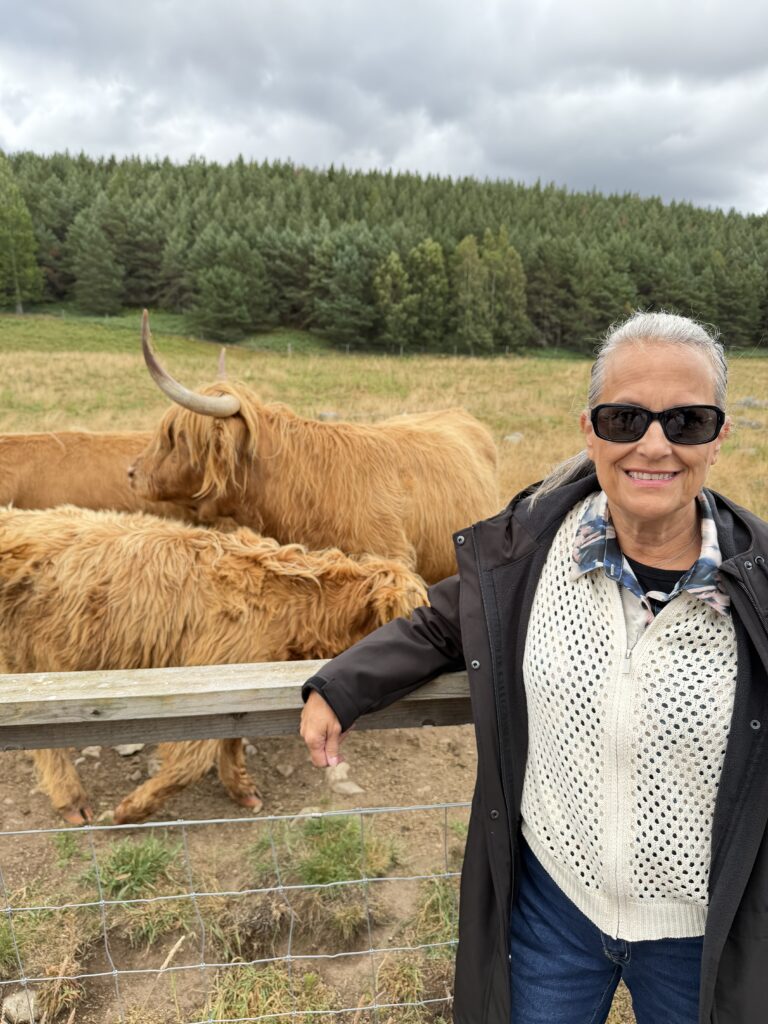
We stepped off the coach into a pasture of Shetland cattle, where Andrew McKenzie, a Highland historian and another piper for the day, met us and played several tunes while everyone found a vehicle. The estate had asked us to come in by their back route rather than the main road for safety, so the drive in was its own small adventure, splashing through a creek, winding through the woods, past red deer, more cattle, and the remains of a World War II training ground and barracks, before finally reaching the several hundred year old home of the Grant clan’s descendants.
Once we reached the house, we were invited inside for a tour before anything else began. Ghillie Basan, a writer, broadcaster, food anthropologist, and one of Scotland’s best known Food Tourism Ambassadors, had coffee, tea, and drams of whisky laid out alongside Scottish pastries on the dining room table, tea sets and crystal spread across its full length. After the drive in, bouncing through the creek and past the old training ground, it felt like stepping into another century, elegant and unhurried, a quiet moment before the walk.
Rothiemurchus Estate
The weather cooperated, no arguing with the rain, and the forest opened up green, lush, and quiet around us. Andrew joined the walk too, still in his kilt with a walking stick in hand, his herding dog Sonsie nose down and hunting the whole way. Andrew is a descendant of the Grant clan that has held this estate for generations, all fourteen thousand acres of it, and it showed in the way he talked, comment after comment about conservation and what it takes to keep land like this intact for the next generation. It clearly mattered to him deeply.
Zeki Basan, Ghillie’s son and the founder and head instructor of Highland Survival Skills, led the way through it all, endlessly knowledgeable, happy to answer any question we threw at him, and entertaining enough that an hour in the woods went by without anyone noticing the time. He introduced us to horse hoof mushrooms, which grow in abundance across the estate, and showed us pieces of a leather-like material made from them. He also explained how the clans once made dye from local plants for weaving into their tartans, and how those colors became a clansman’s identifying mark of land and lineage to anyone who saw him.
Lunch on the Loch
Ghillie greeted us afterward with a full buffet built around the estate’s own resources, including venison from their own herd of Red Deer. She walked the table with us, explaining each dish in detail, and though the room itself was rustic, exposed beams and a big stone fireplace, the meal ranks among the most memorable we had anywhere in Scotland. She paired wine with each course too, and it was clear this was not simply feeding thirty four guests but a real expression of who she is. Ghillie has written her own recipe book, Food, Whisky, Life, part cookbook and part memoir, and the lunch felt like a chapter of it come to life on the table in front of us.
We boarded the Range Rovers again after lunch and bounced back toward the coach, Andrew sending us off with one more tune on the bagpipe. On the way back to the train we passed fire trucks headed toward the wildfires in the mountains, a rare sight in the Highlands and a reminder of how unusual that day had been.
Keith and Inverness
Arriving back at the train in the early afternoon, it began its journey towards Inverness. Guests retired to their cabins, the spa car was busy with treatments, and there was tea and pastries offered in the observation car. We felt a nap was in order before the next adventure when the train stopped again near Keith.
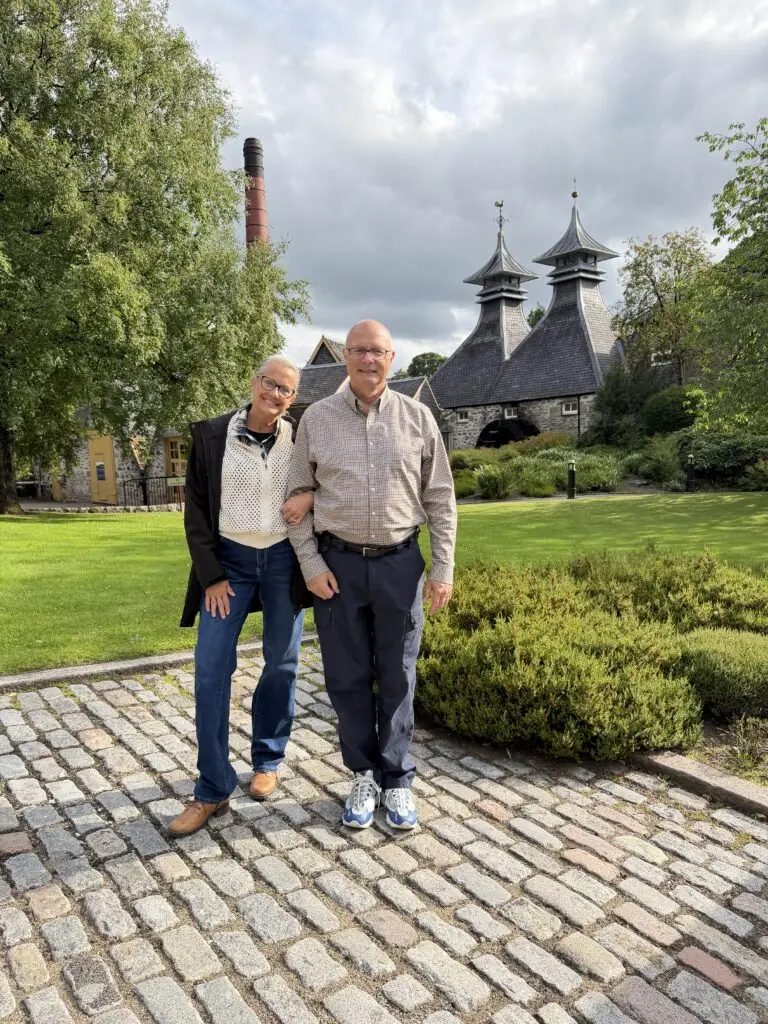
The little village of Keith was quaint and nearly silent that day, a stillness that only added to the visit. Because it was Saturday, the Strathisla Distillery sat closed to regular business, which meant our small group had the run of the entire operation. Only a handful of us made the walk from the train station, but everyone who came had real questions, and our guide answered them well, turning what could have been a dense, technical process into something we actually understood by the end.
Much of the equipment inside dates back decades, kept running not because it is outdated but because it still works, so reliably that the original manufacturers went out of business long ago and replacement parts simply do not exist anymore. After the tour, the guides led us into a sleek, modern tasting room, an unexpected contrast to the historic distillery we had just walked through, for a proper tasting before we made our way back to the train.
Returning to the train, we departed Inverness and traveled down the coast to Dundee, where we would spend the night on a side track. The station there had numerous side tracks running under one long platform roof, a detail that would matter more than we realized once the evening reached its end.
Final Evening and Formal Dinner
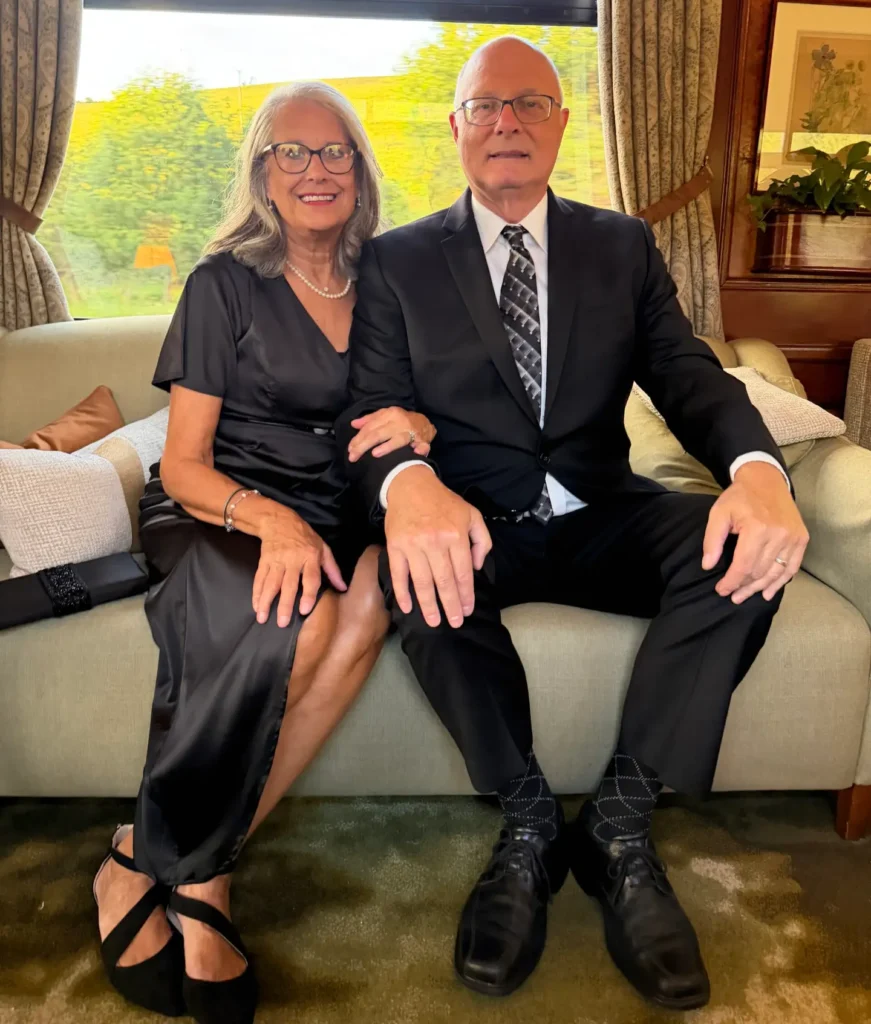
A formal dinner marked our final meal together. The ladies wore gowns in shades of green, brown, navy, and black, while the men chose black tie, tuxedos, or dress kilts, all of it a fitting match for the festive table settings in the dining room. The chef and her staff served five courses built from traditional, seasonal ingredients.
Conversations moved all around the table that night, moving easily from one subject to the next the way conversations do among people who trust each other. One conversation drifted toward something we usually find ourselves more guarded about at home, and the table grew a little more serious for a while, though never unkind. By our last night together, we had grown comfortable enough with Tina, Phil, Theresa, and Alistair to answer their inquiries regarding life and politics in the U.S.
When I asked them about their travel plans ahead, the mood lifted again without missing a beat, back into the easy laughter that had carried most of the trip. Looking back, that small shift, serious and then light again without any awkwardness, said as much about the friendships we had formed in just a few days as anything else that happened on board. Dinner with the group passed too quickly that evening.
Dancing on the Dundee Station Platform
Following the meal, we moved to the observation car for Scottish music and one more round of whisky tasting. As the music wound down, the fiddlers invited us out onto the platform to dance, which meant learning two folk dances on the spot. We laughed our way through it, circling and stumbling until something resembling the steps finally clicked. The music and laughter echoed off the platform roof while trains rolled past and curious passengers smiled at us on their way through the station.
After the last jig, the fiddlers slowed everything down and spoke about friendship, about how we might never see each other again but did not have to forget one another either. Then the lead fiddler played the opening refrain of Auld Lang Syne, and we joined hands and sang two verses together. It was, without question, the most meaningful moment of the trip for me. Before we reboarded, there was a round of embraces and the first real goodbyes. A much quieter group walked back onto the train than the one that had walked off it an hour before.
It’s Pronounced O-bin (not O-ban) Part Two
After a wonderful first five days of our trip to Scotland, we picked up a rental at the Edinburgh airport. Michael then bravely got behind the wheel, and we headed off to the western Highlands on the “wrong” side of the road in a Peugeot 3008. Of course, we left in a heavy rainfall, because that is what happens almost daily in Scotland. This kind of weather is referred to as oorlich, meaning undesirably damp, nippy, cold and chilly. It is a grand chance to accentuate the Scots ‘ich’ sound. (NOT to be pronounced ‘oor-lick’!)
We passed the Kelpies, two 98’ steel horsehead structures as we drove west then north towards our next destination, Oban, one of the larger cities on the Atlantic coast. It is also known as the seafood capital of Scotland, and as is often pointed out on signs in the city pubs, it’s pronounced O-bin
Out of the Lowlands
The drive was an introduction to narrow or [barely] single lane, twisting and turning roads and driving at 45 mph. The traffic flow in Great Britain, which includes Scotland, is right hand side driving. The cars mirror left hand side driving (as in the U.S.), and it all takes some getting used to. Almost every time I approached the car, I would hear Michael behind me quietly reminding me “It’s the other side, Darling”.
Only about a half hour in the landscape began to change from gentle rolling hills to mountains peaks and deep valleys all surrounding huge lochs. The lochs (lakes) run for miles in some cases, and when the sun shines, they shimmer. If it is cloudy or raining, they become dark and gray, almost ominous. The roads rise and fall with the high hills and mountains alongside them. This causes the view to completely change in short distances. It is almost magical.
When the land flattens, the pastures are filled with Shetland cattle, sheep and white horses. There is plentiful rainfall in this part of the Highlands, which makes the grass and foliage brilliant shades of green. The wild flowers are prevalent, coloring the landscape with purples, pinks, whites and yellows. It is as picturesque as you can imagine.
Into the Highlands
Adjusting to the different driving style and the narrow roads was stressful, so about 45 minutes out, we stopped at the Artisan Cafe & Deli in Crianlarch for a cup of coffee and a sweet treat. It is housed in a converted small stone church with beautiful stained glass windows and dark wood trim on the inside. Local artisans, some of whom worked at the cafe, display their work for sale inside. Beside the jams, jellies and other giftware, paints, watercolor paper and artists pencils are also for sale. It was a completely delightful interlude on our drive.
This area is referred to as the Gateway to the Highlands and is known for its hiking tours. We took a short walk from the cafe to the River Fillan, which is part of Scotland’s longest river system, the Tay. We were rewarded with beautiful views of waterfalls and overhanging trees on the path. The Fillan Viaduct is not far from here, which we noticed when we entered the Crianlarich area. When we walked back to our car, we were rewarded with the sight and sound of a passenger train running through the hills to a destination further north.
Traveling Onward
Back to the car, we continued now southeast on towards Oban. We learned there are few roads that navigate the Highlands because of the steepness of the mountains and the often extreme length of the lochs. Often you drive opposite the direction of your destination before turning back in the appropriate direction. Our route sent us north, then east, then back southeast. This is not tedious, however, as the landscape all along is breathtaking.
Arriving in Oban about three hours later, we found the No 17 on Promenade, our hotel for the remainder of the trip. It is situated in the middle of the Oban Bay along the esplanade. Our room had large windows looking out onto the Bay and many of the Hebrides Isles. From here we watched the people and car ferries run hourly, sailboats come and go, and people strolling along the waterfront. Downtown Oban was also visible, as was the harbor port and train depot. The Tower of Craig, a major circular monument up the hill in the central part of the city, was a short walk from the hotel in one direction, the Dunollie Castle in the other.
A Day on Isle of Mull
The first full day in Oban we took the Caledonian MacBrayne Ferry to Craignure on the Isle of Mull. The Isle of Skye further north tends to get more attention and visitors, but we found the Isle of Mull charming and still full of interesting sites and stops.
The first stop of the day was Duart Castle, the ancient home of Clan Maclean. Sir Fitzroy Donald Maclean, the 26th clan Chief, bought the castle out of complete ruin in 1911 and spent the next several years restoring it. Restoration of these relic castles is an ongoing process, and so it is here, the most recent in 2014. It sits on a small peninsula, and in the sun, it almost shines white.
Tobermory
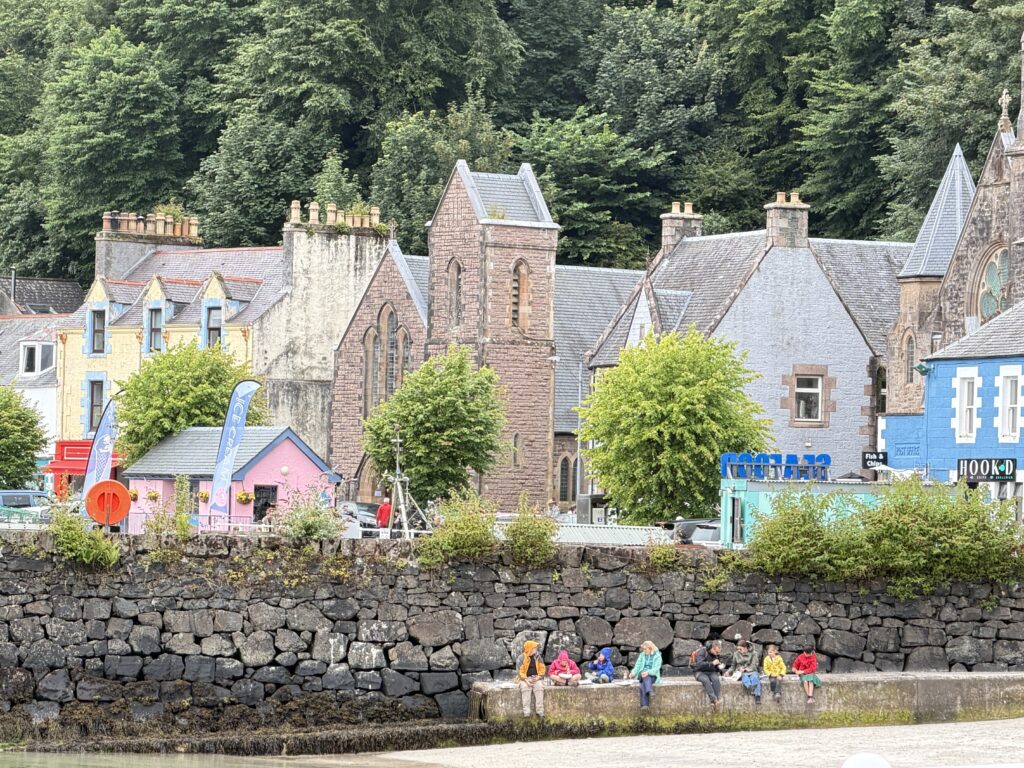
On to our next stop, the colorful harbor town of Tobermory. All the storefronts along the bay’s wall are painted various bright colors. For someone who spent years surrounded by color for a living, this was a respite for my eyes from the prevalent gray. We were hungry by now, so we purchased two boxes of fish and chips, which we ate while sitting in the rain on a curb by the bay. Satiated, we walked along the street, getting out of the rain at the local museum. We had an informative and delightful chat with the docent, Ian, who has lived in Tobermory for over 20 years.
Along the Way
I noticed two large rusted boats along the coast as we drove towards Tobermory, so on the return trip, we checked them out. They are referred to as the Wrecks of Salen, boats that arrived on the Isle in the 1970s, and are now a rustic attraction. (See a Youtube video here by Paul Manorbier.) They now sit on the water’s edge, an almost romantic reminder of fishing days of the past.
Also on the return, we observed numbers of cattle and sheep grazing on the hillsides. I thought of Psalm 50:9 and 10, where cattle upon a thousand hills belong to God.
Fatigue started to set in, so we returned to Craignure to get an earlier departure on the ferry. The rain had stopped, the sun was shining, and we ate ice cream sitting on the shore while we waited.
A Day on Isle of Mull
The first full day in Oban we took the Caledonian MacBrayne Ferry to Craignure on the Isle of Mull. The Isle of Skye further north tends to get more attention and visitors, but we found the Isle of Mull charming and still full of interesting sites and stops.
The first stop of the day was Duart Castle, the ancient home of Clan Maclean. Sir Fitzroy Donald Maclean, the 26th clan Chief, bought the castle out of complete ruin in 1911 and spent the next several years restoring it. Restoration of these relic castles is an ongoing process, and so it is here, the most recent in 2014. It sits on a small peninsula, and in the sun, it almost shines white.
Tobermory
On to our next stop, the colorful harbor town of Tobermory. All the storefronts along the bay’s wall are painted various bright colors. For someone who spent years surrounded by color for a living, this was a respite for my eyes from the prevalent gray. We were hungry by now, so we purchased two boxes of fish and chips, which we ate while sitting in the rain on a curb by the bay. Satiated, we walked along the street, getting out of the rain at the local museum. We had an informative and delightful chat with the docent, Ian, who has lived in Tobermory for over 20 years.
Along the Way
I noticed two large rusted boats along the coast as we drove towards Tobermory, so on the return trip, we checked them out. They are referred to as the Wrecks of Salen, boats that arrived on the Isle in the 1970s, and are now a rustic attraction. (See a Youtube video here by Paul Manorbier.) They now sit on the water’s edge, an almost romantic reminder of fishing days of the past.
Also on the return, we observed numbers of cattle and sheep grazing on the hillsides. I thought of Psalm 50:9 and 10, where cattle upon a thousand hills belong to God.
Fatigue started to set in, so we returned to Craignure to get an earlier departure on the ferry. The rain had stopped, the sun was shining, and we ate ice cream sitting on the shore while we waited.
A Day of Tours
On Tuesday, we took a walking tour and a tour of the Oban Distillery. David, our city tour guide, a semi-retired marine professor, was an excellent historian and an expert in the flora and fauna of the bay and woods we walked through. Our distillery guide, who was very knowledgeable in whisky making and production, is one of a shrinking number of people who still speak Scottish Gaelic fluently. We strolled the streets, checking out shops. Restaurants and inns are plentiful, the Oban Inn being the first structure built in the city. This is a good place for a small bite, a dram of Oban whisky and a game of cards.
A Day of Rest
Wednesday was a day of needed rest. It was raining again. Sir Ranulph Fiennes may have told us “There’s no such thing as bad weather, only inappropriate clothing,” but after several days in the rain, we felt a day of nothing was in order. Michael noticed a number of sailboats leaving the harbor in the morning, and after some quick research, we learned this was the West Highland Yachting Week, run by a Joint Regatta Committee representing three local clubs. 2026 is their 78th anniversary regatta. The boats were racing to Tobermory, where they would moor for two nights, returning again on Friday morning. We watched all morning as the different sizes and colors of boats adorned with their countries’ flags, left the bay.
Railfanning Again
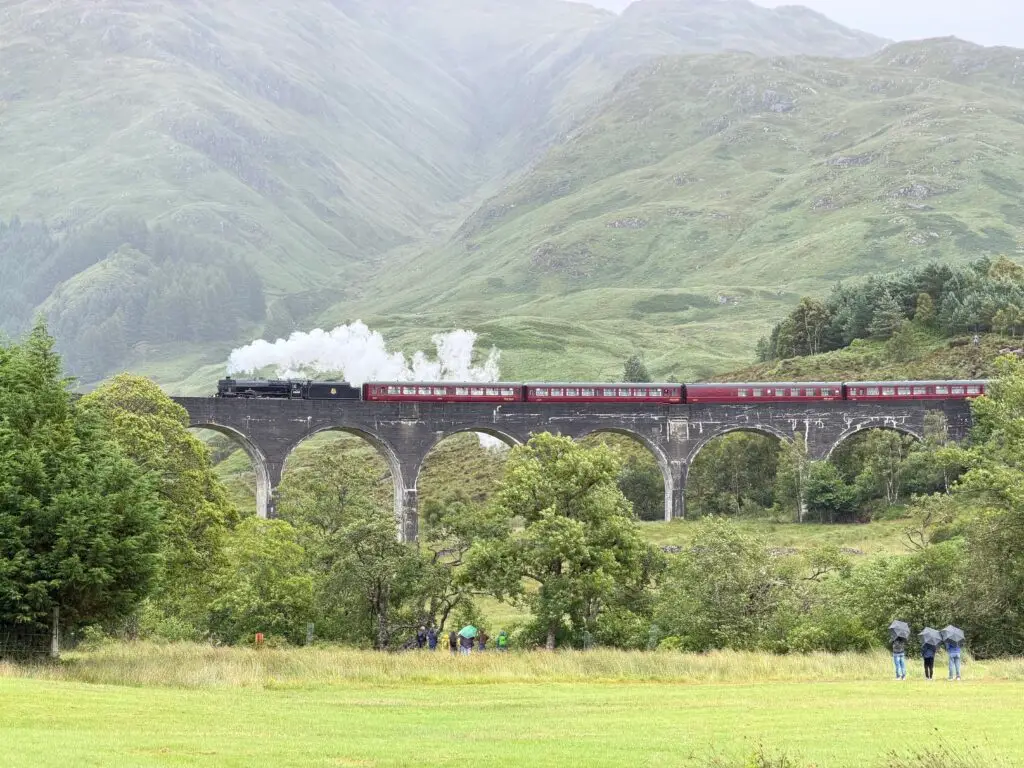
Thursday, we were back in the car on the narrow and winding roads on our way to the Glenfinnan Viaduct to watch the Jacobite Steam Train (aka Harry Potter Train) cross. The 45 minute wait in pouring rain was worth it when the locomotive, puffing white clouds of steam, came around the corner to cross the viaduct, blowing its horn the entire time. Watching it was stepping back in time to an era when this was the only travel through the Highlands.
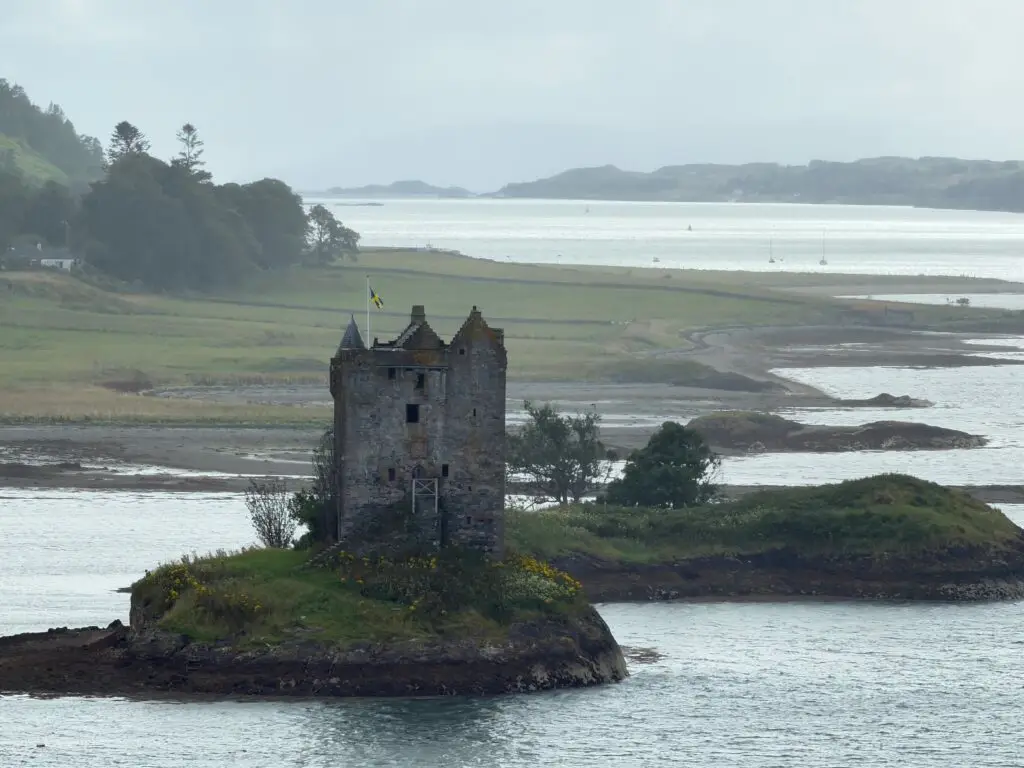
On the return trip, we stopped in Fort William at a pub to dry off and enjoy a pizza and a dram. The pub is located slightly up hill with an expansive view of Loch Linnhe, a great place to sit for a “wee bit”. We then strolled the quaint downtown, ducked into their museum and then headed back to Oban. On the way, we made a coffee and sweets stop at the Linnhe Cafe, still on Loch Linnhe, with a view of the Castle Stalker. This castle, although it looks abandoned, has been restored and is inhabited. It sits on a small island just off the coast and provided some of the best photos of the trip.
Making Our Way to Glasgow
Up and out the door after breakfast, we traveled south around a loch, then north, east and finally south toward our destination of Glasgow. Because we had the whole day, we moved at a leisurely pace, stopping at the Kilmartin Museum, where we were encouraged to pause along the one lane road to get pictures of the ancient standing stones. We had lunch in Inveraray at the George Hotel along Loch Fyne and took time to admire the harbor and loch. The next stop on our itinerary was The Devil’s Pulpit, a trail down to a blood red waterfall and stream, flowing between the towering walls of a moss covered gorge.
This particular stop was a bit of a disappointment at first. We walked through a hay field to the river to see this falls phenomenon, only to find it was too muddy and slippery to get close to the cliff’s edge. The steep climb down and back up was one I was not willing to risk. Turning back, I looked up, and once again, dark clouds had moved in. The rain pelted down as we ran back through the hay field and to the car. Laughing, we pulled out, and we noticed a sign pointing to the Glengoyne distillery. Michael had been there ten years prior while on a work trip to Newhouse near Glasgow. What could we do but stop for another visit?
Glengoyne
Being soaked through, we declined the tour of this modern distillery facility, and went straight to the warmth of the tasting room. As luck would have it, we spent a nice hour sipping some of the best whisky of the trip. Our host provided us with more history and additional knowledge of the whisky industry of Scotland. This trip had been built around the Royal Scotsman and the distilleries of the Highlands. At every stop throughout our time, we found the people kind, hospitable and proud of their heritage in whisky making. It is very much a part of their overall history, and we came away with a new appreciation of both.
Glasgow was not far from Glengoyne, and shortly we found ourselves at the hotel we would stay at for the night. A quick rest and change into evening clothes, we made our way to the city and Cail Bruich, a Michelin star restaurant since 2021. Our menu items were artfully presented and delicious, paired perfectly with the wine selections. We had an 8:30 seating and found ourselves the last to leave at 11:00. The streets of Glasgow were still very lively with people out enjoying the warm evening.
Good bye to Scotland, Hello to Home
Our morning on Saturday started early with the quick trip to the airport. The journey home routed through Amsterdam and back to Chicago. This was a busy traveling trip, one I was not sure I would even be able to take, but it is now chronicled as successful, interesting, and a time we will long look back on and smile. Scotland is an ancient land, with a colorful and rich history, a slowly disappearing Gaelic language, and kind, humorous people. They might have said to us, “Aye, it’s been a braw trip but it’s time to head hame!”I’ll let you check the pronunciations and meanings of that statement!